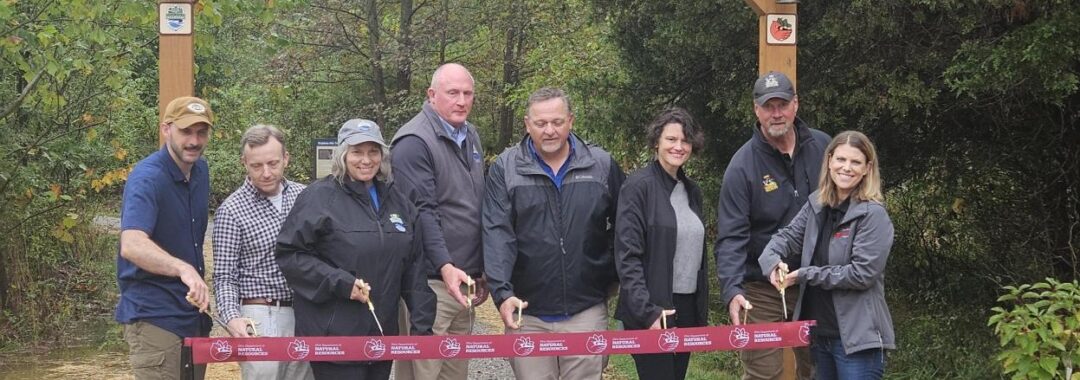
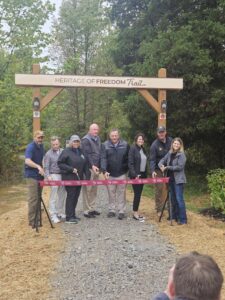
On October 7, the Freedom Center was invited to take part in the opening celebration of the Heritage of Freedom Trail, a half-mile path in East Fork State Park that explores Ohio’s pivotal role in the Underground Railroad. This is the second such trail organized by the Ohio Department of Natural Resources, beginning with the Alum Creek State Park, which opened in 2024.
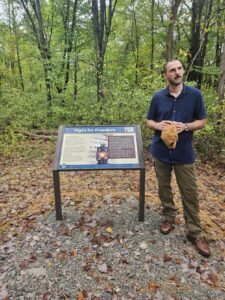
Along the short trail, you'll find various interpretive signs that share how freedom seekers once used Ohio’s wilderness as both a refuge and a route to liberation. Amongst the back-to-back work for the International Freedom Conductor Awards and America's River Roots, the invitation to reflect was a welcome breath for me.
As we navigate uncertain times, the act of coming together in service and community becomes even more vital. We are grateful for the work that the Ohio Department of Natural Resources, Groundworks Ohio River Valley, Ohio State Parks, and so many others put into this project. Their efforts, and those of countless individuals and organizations across our community, remind us of the power of reflection, collective action, and the importance of honoring history.
We hope our friends and supporters of the Freedom Center will be able to make it out to the trail during this brisk fall. Below are my remarks from the ceremony:
Good afternoon. Thank you to the Ohio Department of Natural Resources for asking the National Underground Railroad Freedom Center to be here today. I am honored to represent the Freedom Center and pleased to congratulate you on the opening of the Heritage of Freedom Trail.
I love exploring the natural world. Walking trails like this one rejuvenates me and gives me peace. Often, I let my mind wander, imagining how those without our modern conveniences would navigate the deep valleys and caves, swift creeks and rivers, steep mountains and cliffs. I think about following the stars and the sun for direction, finding shelter and food. All the while finding connection with people generations before me in our shared awe and reverence.
This remarkable trail will allow visitors that same connection. It gives people the opportunity to learn and reflect. The work you’ve undertaken joins a long list of recent accomplishments. As many of you know Ohio has the largest Underground Railroad network with over 100 sites, six being added this year. Ohio has done wonderful work maintaining this history by growing the Ohio Historical Underground Railroad. The Freedom Center hosted the Underground Railroad Gathering in September, which brought together scores of scholars and enthusiasts for several sessions, historical interpretations, documentaries, and networking. America’s River Roots, which kicks off today, is highlighting programming at the Freedom Center to incorporate Black experiences with the river. And the Freedom Journey App developed by River Roots, which will be maintained by the Freedom Center after the celebration, offers information on sites throughout Ohio, custom tours, and information on significant people and historical background.
When I was a kid in the 1980s, I lived in a house on Westwood Avenue in the Cincinnati neighborhood of South Fairmount. If you know the area, a lot of work has been done there to reclaim the natural creek, Lick Run, that once flowed there into the Mill Creek, and then into the Ohio. I remember a man coming to our house from some university because he wanted to study our home and others in the area. It was constructed in 1852 and was positioned right on the street. It was built into a hillside. To enter, you walked into a door and up a long set of stairs that rain alongside a two-story “basement.” There was a large double opening on the street, much taller and wider than a normal garage, that I later learned was used to house carriages and horses. In the upper left corner of our “basement” was a squarish hole in the rock foundation, about 4’ x 4’ that was partially covered by a rotting wooden door. The man from the university thought our house could have been part of the UGRR. I was probably 10 when this happened. I would stare up at that corner and imagine hiding in that dark scary hole. I never went in—it must have been 20 feet off the ground. We moved a year or two after his visit and I never learned what the man discovered, if anything. Today, the house is gone. Demolished as part of the urban renewal project that brought back the creek. Part of the history of the house and its community now lost.
When our history is lost, we lose more than stories — we lose community, identity, and truth. When we lose or ignore history, we erase the struggles and achievements of those who came before us, leaving gaps that weaken our sense of justice and connection. Knowing, understanding, and grappling with our history is vital because it joins us to the people and events that shaped our shared humanity. When we explore the past, we uncover not just the facts, but the emotions, choices, and courage that defined moments of profound struggle and change. History teaches us to see beyond ourselves — to comprehend the lives of those who came before us and the systems that shaped their realities. It challenges us to think critically about freedom, justice, and equality, and to recognize that the privileges and opportunities many enjoy today were built on the sacrifices of countless others who refused to accept oppression as fate.
The history of the Underground Railroad is one of the most powerful examples of resistance, bravery, and solidarity in the face of injustice. It tells the story of enslaved people who risked everything for the chance to live freely, guided by faith, determination, and the courage to imagine a better life. It also honors those who helped them along the way—free Black people, abolitionists, and allies who defied laws and social norms to stand on the side of humanity. Each hidden path, coded song, and safe house represents a triumph of moral conviction over fear.
Teaching this history is an act of social justice. It reminds us that freedom was not given—it was claimed through struggle and unity. We learn through this history that real change often begins with individuals who refuse to remain silent in the face of injustice. These lessons carry forward into our own time, inspiring us to confront inequality and to build communities rooted in empathy, compassion, and courage.
As you step into the woods today, slow down and let the world around you fade. Feel the earth beneath your feet and the air moving around you, heavy with the scent of pine, rain, and moss. Imagine you are walking not for pleasure and curiosity, but for your life—seeking freedom under the cover of darkness. Each branch that cracks beneath your feet could alert someone to your presence. You listen for distant sounds—dogs, voices, footsteps—and steady your breath to stay silent. Your stomach growls, your body aches, but you keep moving. You may hear the call of the barred owl and know that a conductor is nearby. The North Star in the Drinking Gourd is your guide toward the river; the sycamore trees let you know you’re close. As you walk, contemplate the courage it took to trust the night, the land, and the kindness of strangers. Let the forest remind you of their strength, their faith, and their unyielding belief in freedom.